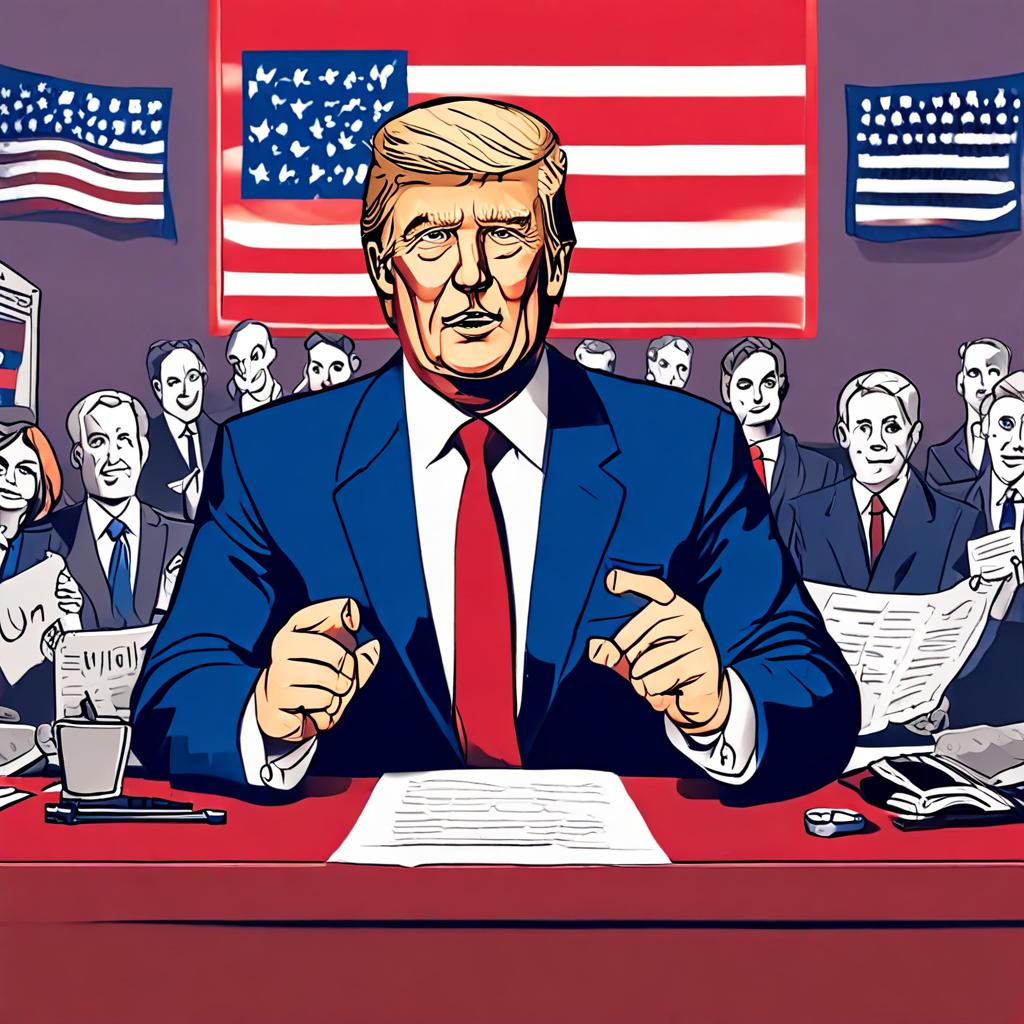
In the United States, comedy has long filled the space vacated by partisan news media. This phenomenon is not unique to the US, as France is also following its lead. Satire, in particular, has become a powerful tool for commentary and critique, often responding more quickly and effectively to world events than traditional news media.
One notable example of satire's power is South Park's depiction of Donald Trump. The show's creators, Trey Parker and Matt Stone, have consistently pushed the boundaries of what is considered acceptable in comedy, and their portrayal of Trump has been no exception. In a recent episode, Trump was shown cheating on Satan with JD Vance in the White House, a move that was both shocking and hilarious.
However, while satire can be a powerful tool for commentary, it is not a substitute for fact-based journalism.aight investigative journalism and criticism. And yet, over the past three decades, the failings of the US corporate media to adequately cover the country's dilapidated politics has pushed people such as Jon Stewart into filling the void.
The problem was identified as long ago as 2000 by the US economist Paul Krugman. He castigated the press for being "fanatically determined to seem even-handed," to the point they were unwilling to call out outrageous untruths. "If a presidential candidate were to declare that the Earth is flat," Krugman wrote, "you would be sure to see a news analysis under the headline Shape of the Planet: Both Sides Have a Point."
It was this context that provided American satire's cathartic triumph in the first years of the 21st century. The Daily Show began conducting harder-hitting interviews than most primetime TV shows. Stephen Colbert rose to prominence by playing a fake conservative talkshow host, in an open parody of Bill O'Reilly's mid-2000s show on Fox. And then John Oliver pioneered "investigative journalism" on his show Last Week Tonight, tackling topics such as net neutrality and the opioid crisis.
However, despite the multiplication of satire, it cannot single-handedly save democracy. As Krugman noted, the press's failure to adequately cover politics has pushed satirists into filling the void, but this is not a substitute for fact-based journalism. Satire can be a powerful tool for commentary and critique, but it is not a substitute for the hard work of investigative journalism and criticism.
In conclusion, satire has become a vital source of truth and commentary in the post-truth era of Donald Trump. However, despite its multiplication, satire cannot single-handedly save democracy. As economist Paul Krugman noted, the press's failure to adequately cover politics has pushed satirists like Jon Stewart into filling the void, but this is not a substitute for fact-based journalism.
In the United States, comedy has long filled the space vacated by partisan news media. This phenomenon is not unique to the US, as France is also following its lead. Satire, in particular, has become a powerful tool for commentary and critique, often responding more quickly and effectively to world events than traditional news media.
One notable example of satire's power is South Park's depiction of Donald Trump. The show's creators, Trey Parker and Matt Stone, have consistently pushed the boundaries of what is considered acceptable in comedy, and their portrayal of Trump has been no exception. In a recent episode, Trump was shown cheating on Satan with JD Vance in the White House, a move that was both shocking and hilarious.
However, while satire can be a powerful tool for commentary, it is not a substitute for fact-based journalism.aight investigative journalism and criticism. And yet, over the past three decades, the failings of the US corporate media to adequately cover the country's dilapidated politics has pushed people such as Jon Stewart into filling the void.
The problem was identified as long ago as 2000 by the US economist Paul Krugman. He castigated the press for being "fanatically determined to seem even-handed," to the point they were unwilling to call out outrageous untruths. "If a presidential candidate were to declare that the Earth is flat," Krugman wrote, "you would be sure to see a news analysis under the headline Shape of the Planet: Both Sides Have a Point."
It was this context that provided American satire's cathartic triumph in the first years of the 21st century. The Daily Show began conducting harder-hitting interviews than most primetime TV shows. Stephen Colbert rose to prominence by playing a fake conservative talkshow host, in an open parody of Bill O'Reilly's mid-2000s show on Fox. And then John Oliver pioneered "investigative journalism" on his show Last Week Tonight, tackling topics such as net neutrality and the opioid crisis.
However, despite the multiplication of satire, it cannot single-handedly save democracy. As Krugman noted, the press's failure to adequately cover politics has pushed satirists into filling the void, but this is not a substitute for fact-based journalism. Satire can be a powerful tool for commentary and critique, but it is not a substitute for the hard work of investigative journalism and criticism.
In conclusion, satire has become a vital source of truth and commentary in the post-truth era of Donald Trump. However, despite its multiplication, satire cannot single-handedly save democracy. As economist Paul Krugman noted, the press's failure to adequately cover politics has pushed satirists like Jon Stewart into filling the void, but this is not a substitute for fact-based journalism.