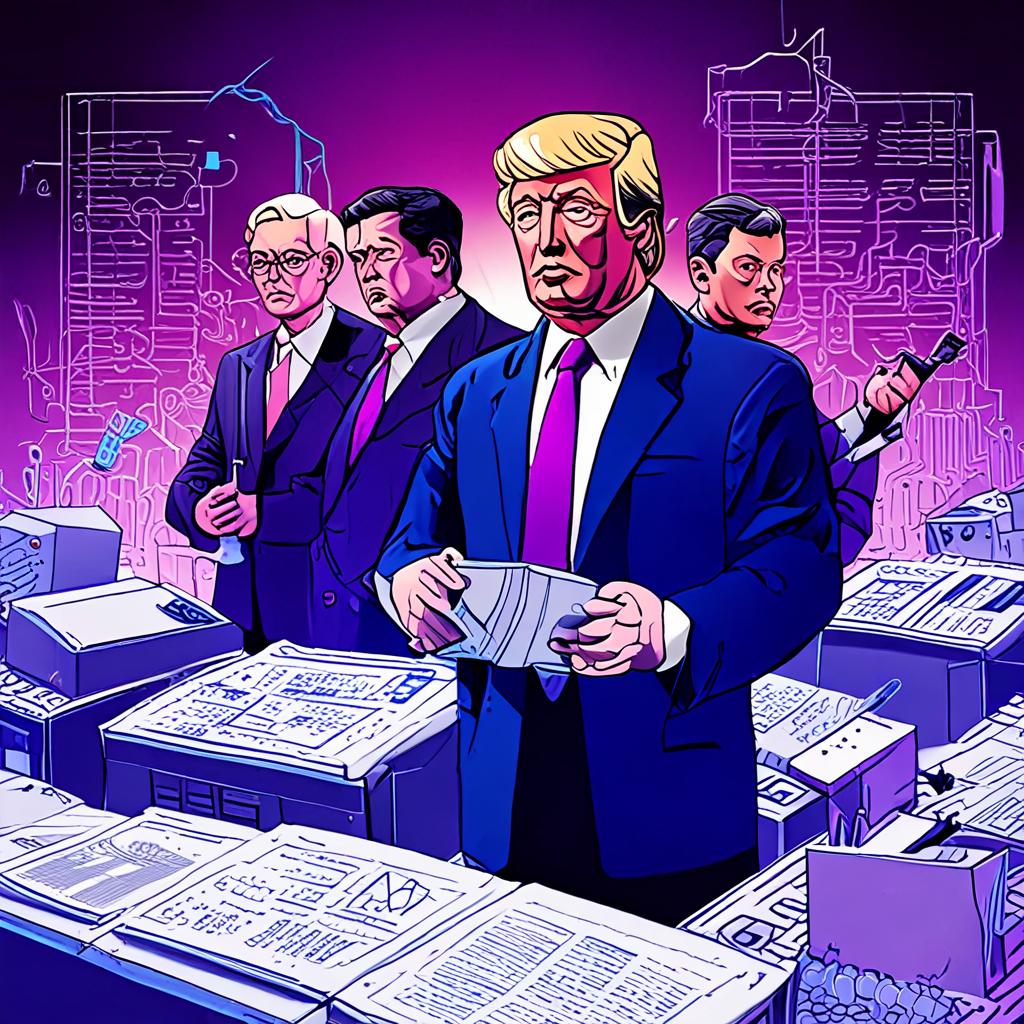
President Donald Trump has announced his intention to raise tariffs on goods imported from South Korea to 25%, in response to the South Korean legislature's failure to ratify the revised Korea-U.S. Free Trade Agreement (KORUS FTA).
CONTENT:
Story mode
President Donald Trump has announced his intention to raise tariffs on goods imported from South Korea to 25%. This is in response to the South Korean legislature's failure to ratify the revised Korea-U.S. Free Trade Agreement (KORUS FTA)
President Donald Trump has announced his intention to raise tariffs on goods imported from South Korea to 25%, in response to the South Korean legislature's failure to ratify the revised Korea-U.S. Free Trade Agreement...
Story step 1
The Korea-U.S. Free Trade Agreement (KORUS FTA), signed in 2011, aimed to boost economic ties between the two nations. However, the agreement faced...
The Korea-U.S. Free Trade Agreement (KORUS FTA), signed in 2011, aimed to boost economic ties between the two nations. However, the agreement faced opposition from both sides, with critics arguing that it led to a trade deficit for the U.S. and threatened American jobs. In May 2017, President Trump announced his intention to renegotiate the deal.
Continue in the field
Carry this article into the map as a focused origin point, then widen into nearby reporting.
Leave the article stream and continue in live map mode with this story pinned as your origin point.
Choose the next useful branch
Follow the same reader branch options as the desktop workspace, tuned for a faster mobile decision.
Story step 2
On July 1, 2020, President Trump announced that he would impose tariffs of up to 25% on South Korean imports if the country's legislature did not...
On July 1, 2020, President Trump announced that he would impose tariffs of up to 25% on South Korean imports if the country's legislature did not ratify the revised KORUS FTA. Trump cited the trade deficit between the U.S. and South Korea as his reason for taking this action.
According to the U.S. Trade Representative's (USTR) 2019 report, the U.S. had a $16.3 billion trade deficit with South Korea in 2018. The main U.S. exports to South Korea include machinery, vehicles, and chemicals, while the primary South Korean exports to the U.S. are automobiles, machinery, and electronic equipment.
Story step 3
South Korean officials have expressed disappointment over Trump's decision and have vowed to take "countermeasures" if necessary. Some experts...
South Korean officials have expressed disappointment over Trump's decision and have vowed to take "countermeasures" if necessary. Some experts predict that the tariffs could harm the U.S. automobile industry, as South Korea is a significant market for American cars.
Carnegie Mellon Institute for Strategy & Technology Non-Resident Fellow Troy Stangarone warns that the tariffs could also jeopardize the security alliance between the U.S. and South Korea, as the two nations have long cooperated on defense and security issues.
Story step 4
To avoid the imposition of tariffs, South Korea's legislature must ratify the revised KORUS FTA. Negotiations between the two nations are ongoing,...
To avoid the imposition of tariffs, South Korea's legislature must ratify the revised KORUS FTA. Negotiations between the two nations are ongoing, and both sides are working to find a mutually beneficial solution.
One possible outcome is the expansion of the agreement to cover new sectors, such as services and digital trade. Another option is for the U.S. to provide more favorable treatment for South Korean automobiles under the tariff scheme.
In conclusion, Trump's threat to impose tariffs on South Korean goods could have significant implications for the economic and strategic relationship between the U.S. and South Korea. The situation underscores the need for continued dialogue and cooperation between the two nations as they work to find a mutually acceptable solution.
Sources:
Bloomberg
U.S. Trade Representative 2019 Report on Trade in Goods with South Korea and Japan.
Cited sources
1 cited references across 1 linked domains.
1 cited reference across 1 linked domain. Source gap watch: Single-outlet source gap.
Trump Vows to Raise Tariffs to 25% on South Korea
For sponsors
Reach readers choosing AI Pulse coverage with 1 cited reference and a clear next-step path.
Package the article, desk, and newsletter path around readers already choosing this context.
Keep reporting
Take the mobile reel into contradictions, event arcs, narrative drift, and the full source workspace.
Stay in the reporting trail
Jump from the app-style read into the deeper source path without losing your place in the story.
President Donald Trump has announced his intention to raise tariffs on goods imported from South Korea to 25%. This is in response to the South Korean legislature's failure to ratify the revised Korea-U.S. Free Trade Agreement (KORUS FTA)
President Donald Trump has announced his intention to raise tariffs on goods imported from South Korea to 25%, in response to the South Korean legislature's failure to ratify the revised Korea-U.S. Free Trade Agreement (KORUS FTA).
CONTENT:
The Korea-U.S. Free Trade Agreement (KORUS FTA), signed in 2011, aimed to boost economic ties between the two nations. However, the agreement faced opposition from both sides, with critics arguing that it led to a trade deficit for the U.S. and threatened American jobs. In May 2017, President Trump announced his intention to renegotiate the deal.
Advertisement
Ad slot: in-article
On July 1, 2020, President Trump announced that he would impose tariffs of up to 25% on South Korean imports if the country's legislature did not ratify the revised KORUS FTA. Trump cited the trade deficit between the U.S. and South Korea as his reason for taking this action.
According to the U.S. Trade Representative's (USTR) 2019 report, the U.S. had a $16.3 billion trade deficit with South Korea in 2018. The main U.S. exports to South Korea include machinery, vehicles, and chemicals, while the primary South Korean exports to the U.S. are automobiles, machinery, and electronic equipment.
South Korean officials have expressed disappointment over Trump's decision and have vowed to take "countermeasures" if necessary. Some experts predict that the tariffs could harm the U.S. automobile industry, as South Korea is a significant market for American cars.
Carnegie Mellon Institute for Strategy & Technology Non-Resident Fellow Troy Stangarone warns that the tariffs could also jeopardize the security alliance between the U.S. and South Korea, as the two nations have long cooperated on defense and security issues.
To avoid the imposition of tariffs, South Korea's legislature must ratify the revised KORUS FTA. Negotiations between the two nations are ongoing, and both sides are working to find a mutually beneficial solution.
One possible outcome is the expansion of the agreement to cover new sectors, such as services and digital trade. Another option is for the U.S. to provide more favorable treatment for South Korean automobiles under the tariff scheme.
In conclusion, Trump's threat to impose tariffs on South Korean goods could have significant implications for the economic and strategic relationship between the U.S. and South Korea. The situation underscores the need for continued dialogue and cooperation between the two nations as they work to find a mutually acceptable solution.
Sources:
Bloomberg
U.S. Trade Representative 2019 Report on Trade in Goods with South Korea and Japan.
Coverage tools
Source path
A compact source board that keeps the article legible while showing what supports the current read and what would most improve the coverage next.
Cited sources
1
Reading points
4
Source links
3
Next checks
1
Source map
Current briefing
President Donald Trump has announced his intention to raise tariffs on goods imported from South Korea to 25%.…
Open briefingSource context
The story is currently grounded in 1 cited source from the live source list.
Next reporting move
A thin source list means the next independent source can materially shift confidence and framing.
Source 01
Trump Vows to Raise Tariffs to 25% on South Korea
Open sourceStory geography
Use the map-native view to understand what is happening near this story and what adjacent reporting is clustering around the same geography.
This story is geotagged. Nearby related reporting is not ready yet, so the live map is the best next context check.
Continue in live map modeCompare coverage, inspect perspective spread, and open primary references side by side.
Linked Sources
1
Distinct Outlets
1
Viewpoint Center
Lean Left
Outlet Diversity
Very NarrowSingle-outlet dependency
Coverage currently traces back to one domain. Add independent outlets before drawing firm conclusions.
Inspect Bloomberg
Open the source dossier to inspect provenance, peer outlets, and lane context before relying on a single article.
Open dossier →Check the live source-balance watch
Frontier can tell you whether this story’s lane has too few sources, one dominant format, or missing stronger anchors right now.
Open frontier →Audit how this story fits your mix
Reader Lens now tracks source-dossier and lane visits, so you can see whether this story expands your overall reading behavior or reinforces a rut.
Open Reader Lens →Search by outlet or domain, then filter by credibility, viewpoint mapping, or the most-cited lane.
Showing 1 of 1 cited sources with links.
Emergent News uses automated assistance to gather, compare, and summarize coverage from 1 cited sources. Review the source list below before relying on the story.